
Personal Safety
Travelers should be aware of their personal safety at all times. Pay special attention and having extra awareness using Social media, other phone apps, taking pictures, and using common sense are imperative while abroad.
It is important for travelers to remain vigilant in regards to their personal safety and security. It is never your fault if you are the victim of assault, no matter where you are.
- Before you leave, share your itinerary with a trusted contact.
- Research ground transportation options. In some areas, public transportation puts a traveler at greater risk for assault, especially if alone.
- Remain vigilant and keep up your awareness at all times. Be cautious about who you give personal details to, including your travel plans.
- Maintain situational awareness at all times.
- When out, always keep an eye on your drink. Do not leave it unattended, even just to go to the bathroom.
- Try not to draw attention to yourself. Practice cultural awareness and culturally agility and try to blend in as much as possible.
- Research your local area and/or ask trusted in-country contacts about the areas of the city to avoid.
- If lost or looking at directions, find a private space away from the crowd to view your map. Have a general sense of where you're going before leaving your accommodations.
- Book vetted, trusted transportation when travelling around. If you’re in a higher risk area, book secure transportation and limit your time off to the hotel facilities.
- Beware of scams, don’t offer your hand, if some touches you, politely ask them not to touch you in a firm, confident posture, continue walking and continue to inform them “no, thank you”.
- Lock your door either your room or vehicle. Don’t open your door to strangers and use the hotel door peephole to see who is there.
If you are assaulted:
- Most importantly, understand that you are not at fault regardless of location or situation.
- Do not risk your safety over material items, hand over everything that the assailant demands.
- If you are able to do so, find a safe place to call for assistance. Remember, sometimes it is not safe to contact local authorities after an assault.
- Do not resist even if you think you may be stronger or you may believe you could get yourself out of the situation. You will not know if the person has a weapon.
- Don’t follow the assailant, this could antagonize them if seen.
- If you have been injured in the attack/robbery, contact the emergency services immediately, if you are able to take yourself to seek medical assistance, do so.
- Call the university's emergency assistance provider, Crisis24, for any assistance.
- If a sexual assault has occurred, take in to consideration that it may not be safe to report the assault.
Do not be afraid or ashamed to seek emotional and/or mental health support. Columbia has multiple resources in place that can assist you with getting the assistance you need.
For more information: Crisis24 Assault and Robbery Security Advice
For Victims of Sexual Assault:
- Pathways to Safety International - Serves Americans abroad
- RAINN (Rape, Abuse & Incest National Network) - Domestic U.S. only
- Columbia Health: Sexual Violence Response
- Be cautious when posting any travel plans on social media, especially the dates you will gone and where you are traveling to. Criminals watch social media accounts to see when people are area from their homes, which gives them the opportunity for burglary.
- Be aware of the social media laws and/or restrictions in your destination. Some governments monitor social media platforms. In some instances, it could be advised to delete your social media until you return from your trip.
- It is advised to avoid posting personal opinions or views and publications about the destination country's government or military.
- Make sure to keep an open communication with those who know you are traveling.
- If you decided to stay active on social media (i.e. posting regular updates and/or pictures) and go silent suddenly, someone on your friends list might worry about your wellbeing. If you are going to a region with limited internet access, or just need a break from social media, it is advised to let you loved one's know.
- Even if asking for suggestions from locals about where to go, it is strongly recommended that you not tell them your exact plans or location (i.e. the name of your hotel or the intersection your accommodations are on).
- Be cautious about revealing personal information and travel plans when talking to strangers.
- "Use different photos for your dating profile. It’s easy to do a reverse image search with Google. If your dating profile has a photo that also shows up on your Instagram or Facebook account, it will be easier for someone to find you on social media." (RAINN)
- There are stereotypes in other countries regarding dating apps and the people who use them. You should familiarize yourself with the local dating culture and be cognizant of any social or dating norms that differ from your home country.
- If meeting someone in-person, video chat with the person before your meetup (this helps prevent "catfishing" and ensures you are meeting the person in the pictures).
- If meeting someone from an app in-person, make sure to familiarize yourself with the location you intend to meet up with them.
- Research and pre-select an area you are familiar with and/or comfortable with. It is advised to choose a busy restaurant or location where there are other people.
- Make sure a roommate, friend, and/or trusted contact knows when and where you are meeting someone.
- During the meetup, or date, it is advised to limit your alcohol consumption. Do not take a drink from a stranger.
- Make sure your phone is sufficiently charged.
- If you feel uncomfortable, "trust your gut" and feel free to leave a date and/or cut off communication with the individual making you uncomfortable.
- Share you meetup/date details with a roommate, friend, and/or trusted contact. Provide them with a screenshot of the individual's dating profile, name, phone number, and/or social media platforms.
Additional resources:
- - OnCall International - Dating Apps and Travel: Safety Advice and Considerations
- - RAINN - Online Dating and Dating App Safety Tips
Before a traveler beings taking pictures, it is important to be aware of privacy and consent. Be cognizant that some people and some situations (i.e. cultural or religious ceremonies) should not be photographed out of respect for the people and their ceremonies.
Pictures of People and Places:
- Understand that in some locations it can be inappropriate, and in some cases even illegal, to take pictures or videos of individuals, ceremonies, indoors and outdoor certain locations. If you are not sure, it is better to err on the side of caution and not take pictures. You can also ask any security, staff members of the location, and the individual person (if an adult).
- Be aware that some structures such as government buildings, police stations, military facilities/personnel, voting centers, religious centers, and residential locations (i.e. palaces) may have restrictions on taking pictures.
- Be aware that close contact with children, including taking their pictures, can be deemed as inappropriate and can cause panic by the local community.
- Children and minors are protected by The United Nations Convention on the Rights of the Child and there are high expectations regarding the privacy of a child.
- If taking pictures of children there are many things to take in to consideration: do you have the parent/guardian's permission, is the child appropriately dressed, why is do you want to take their pictures, will the picture be distributed in any way (i.e. are you posting to social media), does their face need to show. Respecting privacy of children is of the utmost importance and their parents wishes must be respected.
- It is extremely important to promotethe dignity of the people and communities abroad and to respect their people, cultures, and important structures. If you are not permitted to take a picture of a person, ceremony, or location, you should respect those rules/wishes.
- A traveler should always ask an individual or group before taking their picture or picture of a religious/cultural ceremony. Be cognizant that some ceremonies are private and photos or videos should not be taken.
- Disrespecting sites by climbing on monuments or posing in a manner locally considered indecent can lead to significant penalties and consequences, including fines and deportation.
Other Safety Considerations:
- Cameras can be a target for theft. Make sure you keep your camera in a bag if not taking pictures or videos.
- A bag with lockable zippers is recommended.
- When traveling with equipment, a traveler should make sure it is covered by insurance.
Additional resources:
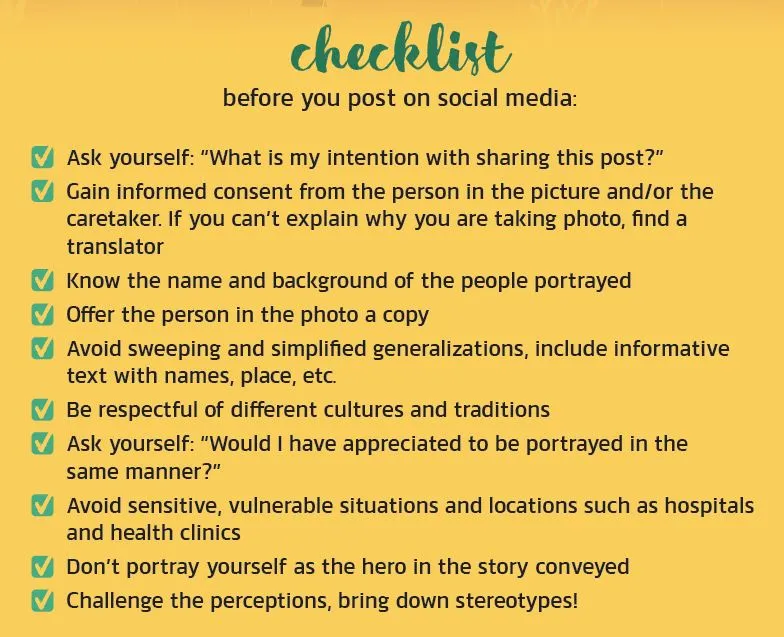
- Radi-aid: A Social Media Guide for Volunteers and Travelers (the checklist below comes from the Radi-Aid website)
- Unite for Sight: Ethics and Photography in Developing Countries
Travelers should always remain aware of their surrounding, especially in a location they are not familiar with. While using common sense or "street smarts", travelers should try to remember the following:
- Keep a low profile and dress in accordance with local laws or local social/cultural norms.
- For example, if in a location where no one wears baseball caps, leave yours at home.
- Be cognizant of what behaviors might be deemed as inappropriate. These can vary from country to country, and even city to city, but some could include acts such as public displays of affection (kissing, handholding), drinking alcohol, and certain types of dress.
- Travelers should be aware not to flash their valuables and to keep a close eye on their valuables.
- It is always advised to not travel alone after dark. If this is unavoidable, walk in well-lit areas where there are small groups of people. Share your location with a trusted contact.
- Report any suspicious behavior or activity to police or other law enforcement (if comfortable doing so and in a location where it is safe to do so).
- If attending an event:
- Know your three exit points in case of a safety or security threat. Be aware of your emergency exits - your way in, may not be the best way out.
- Wait a few minutes after the event has ended for the crowd to disperse.
- Adhere to local/emergency directives at all times.
- Keep your phone charged with plenty of talk time in case of an emergency. If something happens, respond to any University communications immediately and let loved ones know you are safe.
- Program any emergency contacts into your phone. This includes local emergency services, your in-country program coordinator, homestay information, roommate, and Crisis24.
No single treatment exists to combat jet lag or its effects. However, scientists who study circadian rhythms have developed useful recommendations and guidelines to help minimize the symptoms of jet lag. Some of these guidelines are more complicated than others. The information below attempts to present simplified, best practice information for travelers.
Duration of Jet Lag
Everyone responds differently to jet lag, so recovery times will vary. Some travel experts believe that westward travel is easier to adjust to than eastward travel, because the normal body rhythm adjusts better to a longer day than a shorter one. There is a general rule that it takes one day to adjust to each time zone of travel.
Treatment
- Generally, immediately adopt the time of your destination.
- Eat and sleep at the new time. If a nap is required to make it through the day, set an alarm and don't let the nap exceed one hour.
- Avoid caffeine and alcohol. Alcohol makes you feel sleepy but it actually disturbs sleep.
- When awake at night, keep the lights low, read or engage in a quiet relaxing activity.
- Daytime exercise in sunlight helps the body adjust.
- If traveling east, try to get exposure to morning light and if travelling west opt for afternoon sunlight.
- If possible, plan your schedule to allow for some initial adjustment time before engaging in strenuous activities or important business meetings.
For more: Crisis24 Advice on Jet Lag
International air travel entails many concerns that do not affect domestic flights. These tips should help you avoid issues related to international air travel.
Selecting and Securing Luggage
- Checked luggage should be chosen with security in mind. It is recommended that it be well-used, hard-shelled and lockable. Consider a secondary measure to secure the bag, such as luggage belts or plastic wrap which may be available after security screening.
- For carry-on luggage, choose soft-sided, lockable, zippered bags. Take only what you need when traveling; if possible, use only carry-on luggage to prevent loss.
- Consider handbags, backpacks, fanny and tummy packs as a desirable target for thieves at any time.
Prior to Departure
- Ensure the airline has the correct information about who to contact in case of an emergency.
- Check with each airline on the itinerary for the number, weight, and size of carry-on items and checked baggage accepted, as well as additional fees that may be charged if you are over the limit.
Inform the airlines on the itinerary if you require pre-boarding or assistance in the airport and/or boarding the flight.
During the Flight
- Consider wearing compression socks if necessary to reduce swelling and pressure on the muscles in your legs, ankles, and feet. Plan to move around and drink plenty of water.
- Plan to arrive at airports for check-in at least three hours before your international flight.
- Be aware of any special security conditions and clearance requirements that may delay check-in. Arrive at the airport with enough additional time to accommodate these potential delays.
If your flight is completely booked, or you are traveling during holidays or special events, plan to arrive earlier to avoid long lines.
Luggage
- Pack with the expectation that your luggage will be pilfered.
- Do not pack jewelry, passport, cash, credit cards, medications or other valuables in your checked luggage. Carry the minimum valuables necessary and carry them on you or in carry-on luggage.
- If valuables are in carry-on luggage, keep them in a separate tote that you can remove. Smaller planes have smaller overhead bins.
- Ensure you remove tags and stickers from previous flights to prevent errors in routing luggage.
- To lessen customs disruptions, keep prescription drugs in a carry-on bag and in their original, labeled containers. Bring a copy of each prescription and the generic name for each drug; if a medication is unique or contains narcotics, carry a letter from your doctor specifying your need.
- Avoid using black luggage, as this is the most common for thefts, and use ribbon, colored tape or other unique means to identify your luggage.
- If you must use tags, use covered ones. Only include name and telephone number; preferably one at your destination, if known. (Thieves sometimes use luggage tags to identify empty homes for burglary.)
- If your departure country or destination allows, lock your luggage and secure bags with a strap, preferably one with a combination lock. Combination locks are more secure than key locks. Using locks approved by the U.S. Transportation Security Administration will reduce the chances that your lock will be cut off if security officials need to open your luggage but know that keys to these locks are readily available to anyone.
- If your departure or destination country does not allow locks, use an unlocked security strap but note it will increase the chance of your luggage to be chosen for hand inspection.
- If you do not use a security strap, run a strip of duct tape around the suitcase to prevent it from opening if dropped or mishandled. Pack a roll of tape so you can repeat the process.
If locks can be used, reset multiple locks on suitcases to different combinations.
While Traveling
- When going through airport security, place your bags on the belt only as you are ready to walk through the magnetometer, not while still in a line. Immediately recover your belongings on the other side.
- In some locations, any liquids in a carry-on must be in a sealable plastic bag.
- Keep your luggage in sight and close by at airports, railway stations or any public place.
- Switching bags is a common practice of thieves at transportation and hotel counters. To help prevent this, mark your piece with a ribbon or tape.
- Unattended luggage may be removed and or destroyed by security staff. If this happens, you will not be compensated.
- Do not approach or remain near someone else's unattended baggage.
- Do not agree to guard a stranger's luggage nor ask someone to do the same for you.
- Upon arrival, be present when luggage arrives at the baggage area, verify baggage claim checks and quickly inspect your luggage for tampering.
- If you must set down your luggage, place them against a wall or counter and maintain contact with them.
- Watch your luggage being loaded into your taxi or van at the airport and hotel. If possible, take your carry-ons inside the vehicle.
- If you take a taxi, pay the fare only after your luggage is unloaded and is under your control.
For more information: Crisis24 Advice on International Flights and Keeping Luggage Secure
Prepare your trip
- Gather as much information as possible on your destination, refer to our country page and the Crisis24 latest alerts on the Horizon platform.
- Be aware of the local culture and laws. Learn a few words in the local language to be polite and ask for help if needed.
- If you can, plan your trip while ensuring you have a trusted contact with you at every step. You should also have information on your accommodation, relevant embassies, and trusted local contacts easily accessible.
- If it is not possible for you to be accompanied by either friends, colleagues, or trusted contacts, provide your friends, family, or colleagues with a copy of your travel itinerary.
- Consult a map of the city you are going to and make sure you know the location of the airport, your hotel, your meetings, your Embassy, etc. Get to know the city and which neighborhoods should be avoided.
Make sure to know how to go from one point to another the safest possible way.
Once you have arrived
- Always be reachable and keep your cell phone charged at all times. Always carry with you the most important telephone numbers such as Crisis24, your Embassy, colleagues, driver, hotel, etc, make sure they are saved in your cell phone but carry also a paper copy.
- Try not deviate from your itinerary. Avoid disreputable districts and dark areas at night.
- Always carry with you an ID card or passport and emergency medical information. And store copies in a safe place and make sure you have digital copies available.
Avoid discussing sexual orientation, personal, cultural, or politically sensitive issues.
When going out
- When in a taxi or rideshare, do not sit in the front passenger seat.
- In some cultures, smoking might not be accepted, especially during a religious festival, avoid smoking in public.
- Avoid drinking alcohol, especially in Muslim countries. If you do so, only drink alcohol in your hotel and not in a public venue.
- During Ramadan, foreigners are expected to adhere to traditional practices while in public, including refraining from eating, drinking, or smoking in daylight hours.
- Avoid any public gatherings, protests, and rallies that present a dynamic and volatile environment.
You should only travel with minimal non-essential valuable items, and valuables should not be displayed publicly. Vary routes and times and minimize travel after dark.
How to react
- Trust your instincts. If you enter a hotel or restaurant and feel the atmosphere is not welcoming, you're probably right. Don't grin and bear it, just walk straight out.
- Keep your distance, even innocent, friendly talk can be misconstrued as flirtation, as can any physical contact.
- Ignoring most verbal harassment is usually the best policy. Very few will persist following or cat-calling for more than a few meters if you act as if you haven't noticed them. Walk and act confidently; persistent harassers tend to latch onto those who look like they don't know what they're doing.
- For serious encounters and any incidences of physical contact, don't be afraid to create a scene.
- Police and local security services are not trustworthy in every country of the world. If something happens to you and the country you visit is in this category, contact Crisis24 for assistance.
For more information: Crisis24 Advice When Travelling Alone